Hope Gardens
From the earliest days, in the late 1870s, the Gardens at Hope seem to have included an element of instruction, or passing on knowledge, which eventually led to the establishment of the Farm School, after more than two decades of discussion of the issues of agricultural education.
BULLETIN
OF THE
DEPARTMENT OF AGRICULTURE
EDITED BY
WILLIAM FAWCETT B.Sc, F.L.S.
Director of Public Gardens and Plantations.
1906
pages 33-35
HOPE GARDENS.
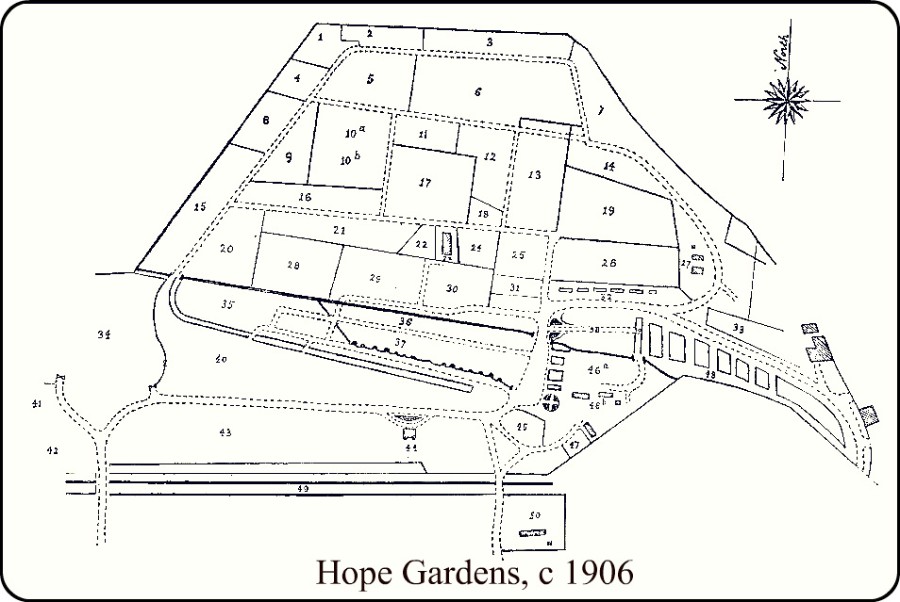
The cultivated area at the Hope Gardens contains not only an
ornamental garden but also an Experiment and Teaching Station.
The first beginning of an Experiment Station at Hope was in
1874 under Mr. Robert Thomson. The Government came into
possession of 200 acres of land there in 1873, and determined to
transfer the new varieties of Sugar Cane, received from the Botanic
Gardens of Mauritius and Martinique and planted in the small garden
at Castleton, to the ample area at Hope. Nearly 18 acres were
put under Cane in 1874, and 5 more in 1875, and during the same
year 10 acres were planted in Teak. A small nursery was also
formed. In 1885, Sir D. Morris, at that time Director, proposed
that the land round the nursery should be made into a public park
at a cost of £5,000, though he thought a Botanic Garden could not
be carried on without a system of reservoirs for the storage of
water. However, Governor Sir Henry Norman decided that, as
there were no conveniences at that time for people travelling
cheaply from Kingston, there should be no outlay except gradually
in forming a Garden.
In 1897 the Government transferred the present Director with
Office and Herbarium from Cinchona to Hope, with the intention
of making it the central botanical establishment of the island.
Since that time the Garden has gradually been formed and extended.*
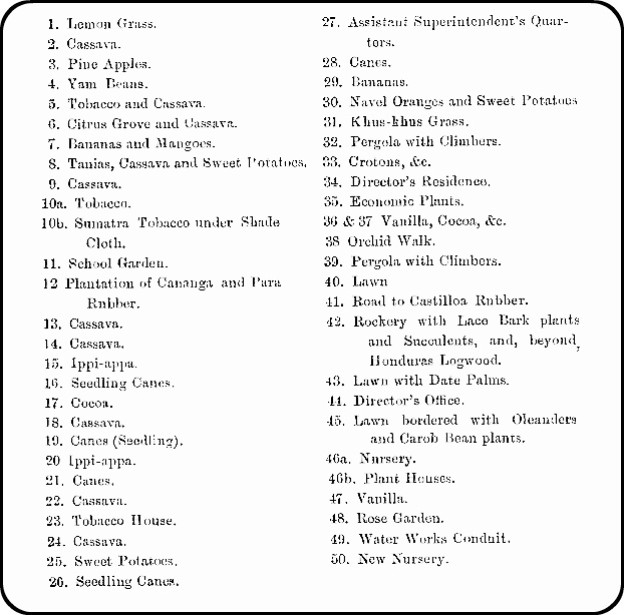
The following plants are grown for experimental purposes, and
also for use in teaching agricultural principles, and the best
methods of dealing with these tropical crops :- Sugar Cane, Cocoa,
Coffee, Tobacco, Banana, Rubber, Nutmeg, Citrus, Grape Vine,
Pine Apple, Cassava, Sweet Potatoes, &c.
Practical instruction is given in the Garden to apprentices, to
boys from the Industrial School, to Students at Training Colleges,
to Elementary School Teachers in their vacation, to Agricultural
Students, and to Planters themselves.
There are about 8 acres under Sugar Cane of several varieties
which are being tested by the Agricultural Chemist and distributed
to Planters. Seedlings are grown from seed and are tested as
they mature.
Forastero and Criollo Cocoa are grown, and experiments are
being made as to the effect of shade trees, and as to the difference
in growth, and yield of crop, when planted close and at wider
distances apart.
Coffee of several kinds may be seen :— Arabian or common
Coffee, Liberian, Abbeokuta, Highland Coffee of Sierra Leone
(stenophylla), Maragogipe, Golden Drop, &c.
Tobacco is under cultivation, and the leaf is cured in the tobacco
house close by. The apprentices are instructed in all the
details of cultivation, and the technique of curing the leaf for
cigar tobacco. A quarter of an acre of Sumatra seed tobacco is
grown under the shade of cheese cloth. This tobacco yields a
very high-class leaf for the outside wrapper of cigars.
A collection has been established of twenty-three varieties of
Banana from various parts of the world, chiefly obtained through
the kindness of the Director of Kew Gardens and the Commissioner
of the Imperial Department of Agriculture.
Budded Citrus plants have been planted out for comparison,
both of varieties that have proved successful in Florida and California,
and also of native seedling trees. Attempts are being
made to get a variety of Orange which will bear fruit when the
highest prices are obtained in English and American markets.
Pine Apples of several varieties are grown, and experiments
are being made in cross-fertilising different varieties, with the
object, for instance, of getting a pine with the flavour of the Ripley,
the fine appearance of the Smooth Cayenne, and the good
carrying qualities of the Red Spanish.
Rubber plants of various kinds are grown :- Para, Castilloa,
Ceara, Lagos silk rubber, Landolphia, &c.
There are 28 varieties of Cassava collected from different parts
of Jamaica, 10 from Porto Rico, and 30 from Colombia. These
68 varieties are being tested as to weight of tubers per acre, and
percentage of starch. The starch is said to be better for laundries
and for dressing Manchester goods than that produced by
any other plant. It is claimed also that Cassava yields more
starch per acre than ony other plant.
Similar tests, besides value as food, are also carried out with
reference to Sweet Potatoes, — 27 varieties from Jamaica, 12 from
Barbados, and 9 from the U. S. Dept. of Agriculture, Washington,
D. C.
Results of tests of plants are published from time to time in the
Bulletin and Annual Reports.
* see Guide to Hope Gardens by Walter Jekyll. Published by Messrs. Aston Gardner & Co., Kingston. Price, One Shilling.
