garden apprentices ~ industrial school ~ agricultural course at the laboratory
Lagos students ~ Mico courses ~ Jamaica High School/University College
students from Lagos
'. . . in 1889 Thomas Dawodu and George Leigh proceeded to training at Hope Gardens, Jamaica and the Royal Botanical Gardens at Kew. They later took control of the Ebute Metta horticultural station, and in the 1890s toured the whole of Yorubaland promoting agricultural extension policies and providing expertise.' Ecology, climate and empire, Richard H. Grove, 1997, page 159
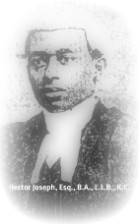
There are numerous references to these two young men from Nigeria, who went on to become important agricultural experts in their own country, but so far I have found no more detail about their stay in Jamaica. The most intimate glimpse comes from a brief reference in a diary kept by Hector Josephs, apparently Jamaica's first Black barrister, while he was studying at Cambridge.
~~~~~~~~~~~~~~~~~~~~~~~~~~~~~~~~~~~~~~~~~~~~~~~~~~~~~~~~~~~~~~~~
In 1889 Governor Moloney, of Lagos, began a then novel scheme for scholarship awards to young Africans to train in horticulture; Thomas Dawodu and George Leigh were the first recipients of these awards, which later became accepted as an important part of colonial policy.
Bulletin of miscellaneous information / Royal Gardens, Kew, 1891
... as follows : — " The Government of Lagos has sent here two apprentices to be trained in practical work at the Botanical Gardens in Jamaica, ... The apprentices have worked in the Hope Gardens, as gardeners work in the Kew Gardens. ...
A room is granted to them at Hope Gardens, and their Government allows them each a provision of 50l. per annum.
~~~~~~~~~~
The Handbook of Jamaica, 1892
Apprentices. — The Government of Lagos has sent out two apprentices to be trained in practical work at the Botanical Gardens in Jamaica, with the view of hereafter appointing them as " working Superintendent of the district branches or ...
~~~~~~~~~~
Daily Gleaner, June 8, 1892
Mr W Fawcett, Director of Public Gardens and Plantations, speaking at a meeting to discuss agricultural issues,at the Merchants' Exchange:
At Hope Gardens, we are also training two youths who have been sent for the purpose by the Government of Lagos. That training of this kind is practical is evidenced by the success already obtained. The present Superintendent of Castleton Gardens was altogether trained in the Department from bis boyhood. Another man trained in the Department is Mr. James McNair, who was selected by me about 4 years ago to start a botanical station at Lagos, under H. E. Sir Alfred Moloney. Owing to the ill health of his family he was obliged to return to Jamaica, and his former Governor now at Honduras, has written to me wishing for his services in founding a botanical station at Belize. Other men trained in the Department have acted as managers of coffee estates, banana walks, &c.
But something more than this practical work is needed. There should be provision made for instruction in the theory of agriculture, and this not only for those who intend to act as managers of estates, but especially for those who are being trained as teachers. Until there is a body of teachers of agriculture, teaching the subject in the schools, we cannot look for any improvement amongst the mass of the people.
BULLETIN OF THE DEPARTMENT OF AGRICULTURE
EDITED BY WILLIAM FAWCETT B.Sc, F.L.S.
Director of Public Gardens and Plantations.
Vol. IV, HOPE GARDENS, JAMAICA, 1906.
p 267
In 1897 the Governor of the colony sent Messrs. Leigh and Dawodu of the Botanical Department [two natives of Lagos who were trained at Hope Gardens, 1890-1893, and subsequently spent a year at Kew] into the interior to report on the condition of the rubber trees in the forests, and to give advice to the kings and chiefs on the proper methods of tapping, and to induce them to devote as much care and attention to the raising and cultivation of this tree as they give to kola and oil palm.
~~~~~~~~~~
from the diary of Hector A Joseph, while at Trinity Hall, Cambridge, studying law:
Saturday April 22 1893
I received today a letter from some Africans - or rather an African. Two, Messrs Leigh and Dawodu, have been studying in Jamaica; I met them just before I left, since then they have seen my people quite frequently. Leigh is good enough to tell me of my people's health, and to inform me of the pleasure he derived from my sister's society. He also congratulates me on my success, as I, like him, belonged to the negro race. It is true that I am sprung partly from the negro, partly from the European too; should I not then combine the qualities of both?
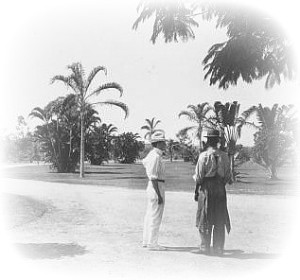
men working at Hope Gardens
